The Tomato’s Long Journey to the Kitchen
Explore the tomato’s journey from the Americas into kitchens elsewhere and see how fresh, cooked, and preserved uses shaped its place in everyday meals.
The most common mistake in telling the tomato’s story is to treat its arrival in a new place as the moment people there first made it food. That shortcut costs us the longer history of cultivation in the Americas and the local choices that shaped its later uses. The tomato’s journey to the kitchen is best followed through those changing uses, not through a contest over who owns a sauce.
Tomatoes belong to the Americas, where people cultivated and ate them long before Europeans carried plants and seeds across the Atlantic. Their spread introduced the fruit to new growing conditions and unfamiliar kitchens. Travel alone did not make tomatoes everyday food: cooks had to decide whether to eat them fresh, cook them with other ingredients, or preserve them for later.
Tomatoes were cultivated and eaten in the Americas before reaching Europe
The tomato’s familiar botanical name is Solanum lycopersicum, but its food history begins with people, not taxonomy. Before European contact with the Americas, Indigenous communities cultivated and used tomatoes as food. The crop was part of established foodways rather than a plant awaiting discovery or a European kitchen’s approval.
That distinction matters because histories of crops can become misleading when they begin at the point of European arrival. A plant may be unfamiliar to one group of cooks and long familiar to another. When tomatoes later entered kitchens elsewhere, cooks encountered an ingredient with an existing history of cultivation and use.
Early European responses varied by place and period
There was no single European reaction to the tomato. In some settings, people grew the plant as an ornamental or approached its fruit cautiously; in others, it entered cooking. These are broad descriptions, not a claim that all Europeans followed one sequence or shared the same beliefs. The timing and path of adoption differed by region and household.
The fruit’s relation to the nightshade family could contribute to caution, but that alone does not explain how people responded. Familiarity with the plant, local growing conditions, access to seeds and produce, and the habits of cooks all mattered. Rather than assign one motive to an entire continent, it is more accurate to describe adoption as uneven and shaped by local circumstances.
Seeds crossed the Atlantic before kitchen habits did
Plants and seeds could travel into European gardens, but they did not carry recipes or instructions for fitting tomatoes into a meal. Gardeners could grow a crop before sellers made it readily available to more households. Cooks then had to work out how its flavor and texture suited familiar ingredients and dishes.
Gardens, markets, and household kitchens each played a different part. Gardeners made plants available; sellers brought produce to people who did not grow it; cooks made the fruit useful in meals. Where tomatoes remained scarce or unfamiliar, they could be a novelty. As cultivation and routine use spread, they became easier to treat as an everyday ingredient.
Fresh preparations made the fruit’s qualities easy to recognize
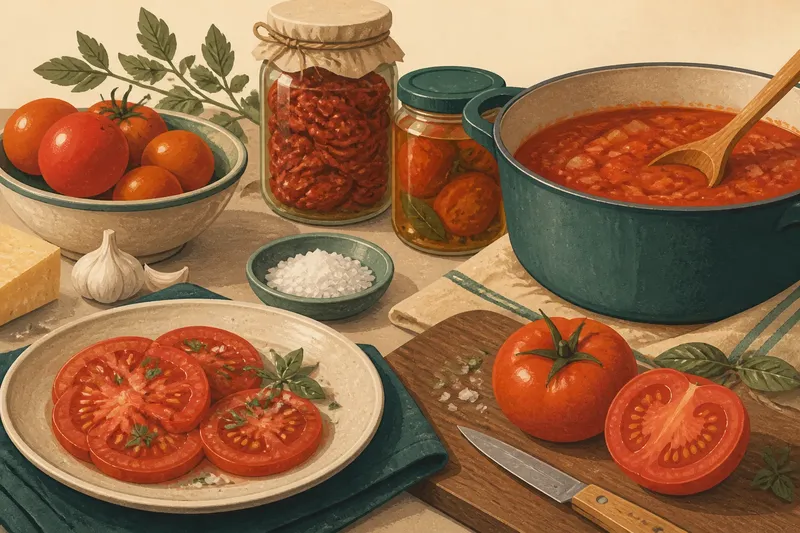
A fresh tomato shows its texture and acidity directly. Sliced or chopped, it can accompany bread, cheese, onions, herbs, or other familiar foods without requiring a cook to restructure a whole meal. The combination lets diners experience what the tomato adds.
How a cook handles a tomato depends on its condition and the dish. A firm fruit can hold its shape in slices; a very ripe one can be crushed into a dressing or spooned over bread. Salt draws out juice, which a cook can serve with the fruit or drain away. These small decisions adapt the ingredient to a meal and to local preference.
Say a household has started growing tomatoes but still serves its usual bread-and-cheese lunch. The cook slices a ripe tomato, seasons it with salt and herbs already in the kitchen, and serves it alongside the familiar foods. The observable result is a juicy, tangy element added to a meal whose basic arrangement remains unchanged. This is one way a new ingredient can enter everyday cooking without displacing older habits.
Cooking made tomatoes a base for other ingredients
Heat changes the tomato’s role. Chopped fruit can soften into a sauce or stew, carrying seasonings and lending body to other ingredients. In a pan, pot, or baking dish, tomatoes become part of the cooking medium rather than a separate accompaniment.
There is no single tomato sauce that represents this change. Cooks can simmer tomatoes with onions and garlic, combine them with peppers, or add them to beans, fish, meat, or vegetables. The dish reflects the ingredients and techniques at hand. A sauce may remain chunky or become smooth; it may be cooked briefly or until concentrated.
Tomatoes can join flavors in different ways. Their acidity can brighten rich foods, while their juices can form a broth-like base. The result depends on the fruit and the other ingredients. When adjusting a pot, a cook can ask whether it needs more liquid, seasoning, or cooking time rather than treating one addition as a universal fix.
Preserving carried tomatoes beyond the harvest
Drying, pickling, and cooking tomatoes into preparations for storage are different ways to extend their use beyond a fresh harvest. Each changes flavor as well as timing: dried tomatoes become more concentrated, while pickled ones take on the sharpness of their brine.
Preservation also involves household labor, storage, fuel, and containers. A cook who preserves tomatoes is planning for future meals, not simply saving surplus. The resulting ingredients can later flavor soups, stews, sauces, and other dishes when fresh tomatoes are unavailable.
Not every preservation method is worth the effort for every household. If space, time, or suitable storage is limited, using fresh tomatoes as needed may be the simpler choice. For home preservation, follow current food-safety guidance and directions for the specific method, since safe acidity and processing depend on the recipe and equipment.
Why did tomatoes become familiar in some kitchens?
Were tomatoes first eaten as food in Europe?
No. People in the Americas cultivated and ate tomatoes before the fruit traveled to Europe. European use is one part of the history, not the beginning of the tomato as food.
Did Europeans all regard tomatoes as dangerous?
No single view applied across Europe. Responses varied by place and period, and broad claims about universal fear or suspicion obscure that variation.
Did one country invent tomato sauce?
No single country can claim every form of tomato sauce. Cooks in different places adapted tomatoes to local ingredients and methods, producing related but distinct preparations.
What helped tomatoes become ordinary ingredients?
Growing, access, and repeated use in meals all contributed. As tomatoes became easier to obtain and cooks learned ways to use them, they could fit more readily into everyday cooking.
Local cooking gave tomatoes many identities
As tomatoes spread beyond the Americas, they met cuisines with different staples, seasonings, and ideas about a meal. In some settings, cooks used them in sauces; elsewhere, they became part of stews, relishes, condiments, or fresh salads. These uses show how cooks adapted an ingredient to existing foodways rather than simply copying one borrowed dish.
A dish can be locally cherished and still include an ingredient with an earlier history elsewhere. Recognizing that layered history does not diminish local cooking. It makes the movement of crops and the choices of cooks more visible.
Names and origin stories can point toward places, languages, or traditions, but a dish’s name alone cannot settle the history of its ingredients or techniques. Recipes change as people move, trade, garden, and cook with available foods. The tomato’s many culinary identities grew through those changes, not from a single act of invention.
Follow the tomato through its uses, not a claim of ownership
A useful way to read the tomato’s history is to follow what people did with it. It was cultivated and eaten in the Americas; plants and seeds later crossed into new growing environments. In unfamiliar kitchens, the fruit could be ornamental, cautiously approached, or used in food. Fresh preparations made its qualities easy to recognize, cooking turned it into a companion for other ingredients, and preservation carried it beyond the harvest.
This is not a universal timeline. Communities adopted tomatoes at different rates and used them in response to local crops, tastes, and methods. The broader sequence offers a way to ask where the plant came from, how it reached a kitchen, and what cooks did with it once it arrived.
A fresh slice beside bread, sauce spooned over beans, or a preserved tomato stirred into a pot each reflects a choice about flavor and convenience. The tomato’s journey to the kitchen is still visible in these meals: an ingredient with a history in the Americas, made familiar elsewhere through generations of local cooking.