The One Authentic Recipe Myth and How to Cook Through It
The one authentic recipe myth turns family and regional dishes into a search for a single correct formula. Learn how to cook with context instead.
The most common mistake with a traditional dish is searching for the one authentic recipe, as if every household has been waiting to agree on a final version. That search can turn cooking into a test of belonging: a cook follows one published formula, then worries that a relative’s or neighbor’s variation is somehow wrong.
Recipes travel through kitchens, languages, seasons, and personal tastes. Their changes are not automatically errors. Treating a dish as a living tradition makes room for its history while helping you decide what to cook, what to ask, and how to describe your own version honestly.
One recipe cannot represent every household
A dish name often points to a family of related preparations rather than a fixed ingredient list. Cooks may share a central idea—a particular grain, cooking method, or place at the meal—while varying the details. Those variations can reflect what grows nearby, what is affordable, what a household avoids, and what its cooks enjoy.
The word authentic can blur these differences when it is used to mean “the only correct way.” A recipe printed in a book or posted online may document one cook’s approach, but publication does not make it the sole representative of a whole region or community. Nor does an inherited recipe become less meaningful because another household prepares the dish differently.
Start by asking what the dish means in the setting you care about. Is it a holiday food, a weekday staple, a way to use a particular ingredient, or something served with a specific accompaniment? Those answers give you better bearings than trying to rank versions by purity.
Family versions differ because kitchens differ
Household recipes often change through ordinary acts of cooking. A cook adjusts salt to suit the ingredients on hand, alters the texture to please children, or leaves out an item a family does not eat. Someone may learn by watching rather than measuring, so the written version records only part of the method.
Memory also edits a recipe. One person remembers the dish as sharper or softer; another remembers a particular garnish or the pan used. Neither recollection has to be treated as a challenge to the other. Ask what each detail does: does it add a familiar aroma, make the food easier to share, or mark a special occasion?
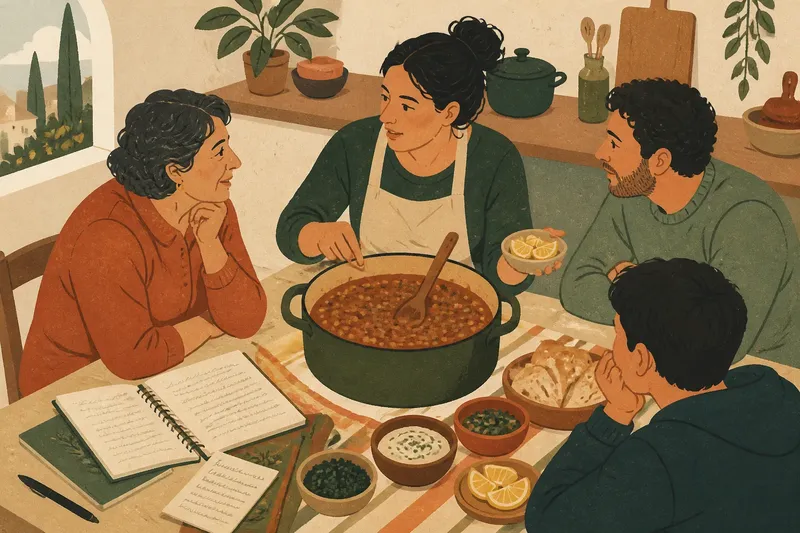
Say you are making a lentil stew from a relative’s handwritten notes, and the directions call for a sour finish that you do not remember from family meals. You could cook the stew as written, then serve lemon separately and invite everyone to add it to taste. The observable result is a shared meal in which the written recipe and family memory can both be discussed without forcing one account to erase the other.
Regional variation follows ingredients and habits
When a dish crosses a border or moves to a new neighborhood, its ingredients and methods may shift. A cook may substitute a locally available bean, use a different cooking vessel, or serve the food with the bread commonly eaten at home. Climate, markets, migration, religious practice, and work routines can all shape what is practical and familiar.
That does not mean every change has the same meaning. Some substitutions preserve a dish’s basic role; others create a version that people may recognize as related but distinct. The useful question is not simply “Is this authentic?” but “Who calls this by that name, and what does the name mean to them?” If you are cooking from a community’s tradition, seek accounts from people who cook and eat it rather than treating a single source as a verdict.
It is not worth the effort to chase down an obscure ingredient just to prove that a dish is legitimate, especially if the ingredient does not define the version you are trying to make. If a substitute changes the flavor or texture, say so plainly; that is more useful than pretending the two ingredients are identical.
When does a variation still belong to the dish?
Does every traditional dish have an original recipe?
Some dishes have identifiable roots, but their everyday forms may have developed across many cooks and settings. A documented early recipe can be valuable evidence without serving as a rule that later households must follow.
How can I adapt a family recipe without losing its character?
Keep the elements your family recognizes as central, such as the main ingredient, cooking texture, or customary way of serving it. Change one detail at a time and note what you changed, so you can explain the choice and return to the earlier version if you prefer.
Should I call my version authentic?
Use the word carefully, and name the source or context when you can: “my aunt’s version” or “the version I learned in this household” is more precise. If you have adapted it, describe the adaptation rather than claiming it speaks for everyone who shares the tradition.
What should I do when relatives disagree about the recipe?
Ask each person to describe the version they remember and the occasion when it was served. You can cook one version first, then make another at a future meal, without deciding that one memory cancels the other.
Cook with context instead of chasing a verdict
A practical way to approach an unfamiliar or inherited recipe is to keep a short record beside it. Note who shared it, where they learned it, when the dish is usually eaten, and which details they consider important. If the source is a cookbook or community collection, record that too. These notes distinguish a specific account from a universal claim.
Then choose your goal before you cook. You might be trying to reproduce a family memory, understand a regional style, or make a satisfying dinner with available ingredients. Each goal invites different decisions. For a memory, ask the person who remembers the dish what detail matters most. For a regional style, compare accounts from cooks within that tradition. For dinner, adapt freely and describe what you made.
The one authentic recipe myth loses its grip when a recipe is treated as an invitation to learn, not a credential to earn. Keep the name, the source, and the changes clear; listen when someone explains what the dish means to them; and leave room for another household to cook it differently. A useful recipe can carry its history forward without pretending the story has reached its final version.